
Ethical Storytelling Guidelines for Nonprofits
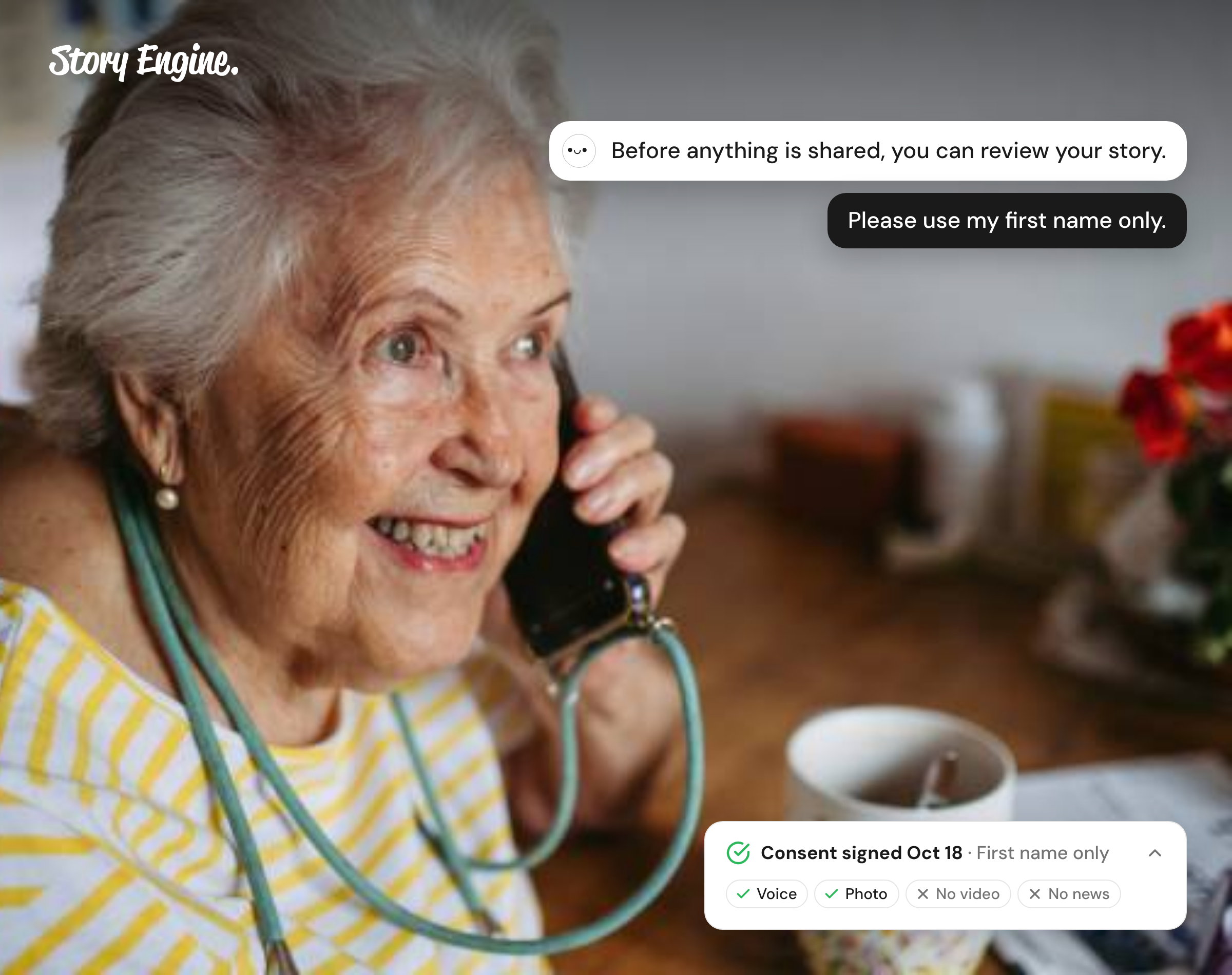
Ethical storytelling means sharing real-world experiences by centering human dignity, safety, and ongoing consent, ensuring individuals own and co-create their narratives rather than being exploited for emotional gain. When collecting and sharing impact stories, nonprofits always have a responsibility to the storyteller first.
Start collecting impact stories with Story Engine
This guide covers informed consent, dignity and framing, trauma-informed practice, safety and privacy risks, what to do if a storyteller becomes distressed, and when to bring in a qualified professional. It also shows how to use Story Engine to collect stories with care, while being clear that no tool can replace human judgment or follow-up.
A note before you begin
This guide wasn't written by trauma specialists, lawyers, or safeguarding professionals. It draws on published guidance from organizations with that expertise, which we name throughout and list at the end. It is not a substitute for trained support, your organization's safeguarding policies, or qualified legal advice.
If your organization collects stories about abuse, violence, serious illness, immigration status, or other sensitive issues, we strongly encourage you to consult your own safeguarding lead, legal counsel, or a trauma-informed practitioner before you begin. The same applies to any story involving a child.
What does informed consent actually mean in storytelling?
Informed consent means a person understands exactly what they are agreeing to before they agree to it. Bond's ethical guidelines describe informed consent as "the cornerstone of ethical content gathering." In storytelling, that includes what you will record, where it will appear, who will see it, and for how long.
Consent also needs to be free from pressure. As Bond's 2025 guidance puts it, you must make it very clear that declining to participate does not affect any benefits the person may receive from your programs. If someone feels they must say yes to protect their access to services, that is not consent.
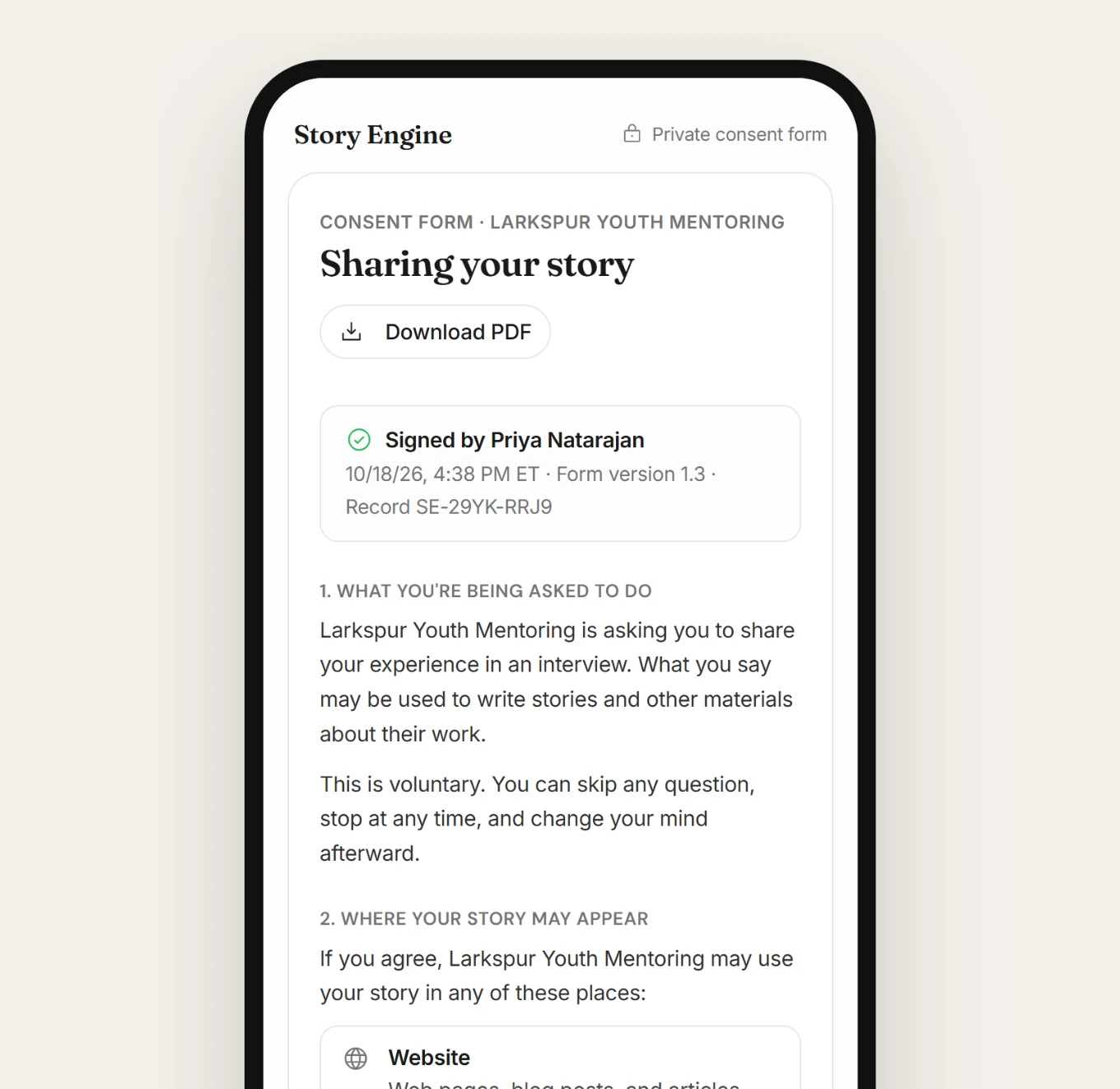
Consent is an ongoing conversation, not a one-time signature. SOS Children's Villages' ethical storytelling guidelines recommend recording consent appropriately and reconfirming it. Keep a copy of every signed consent form. When something about a story changes, such as a new publication channel, go back and ask again.
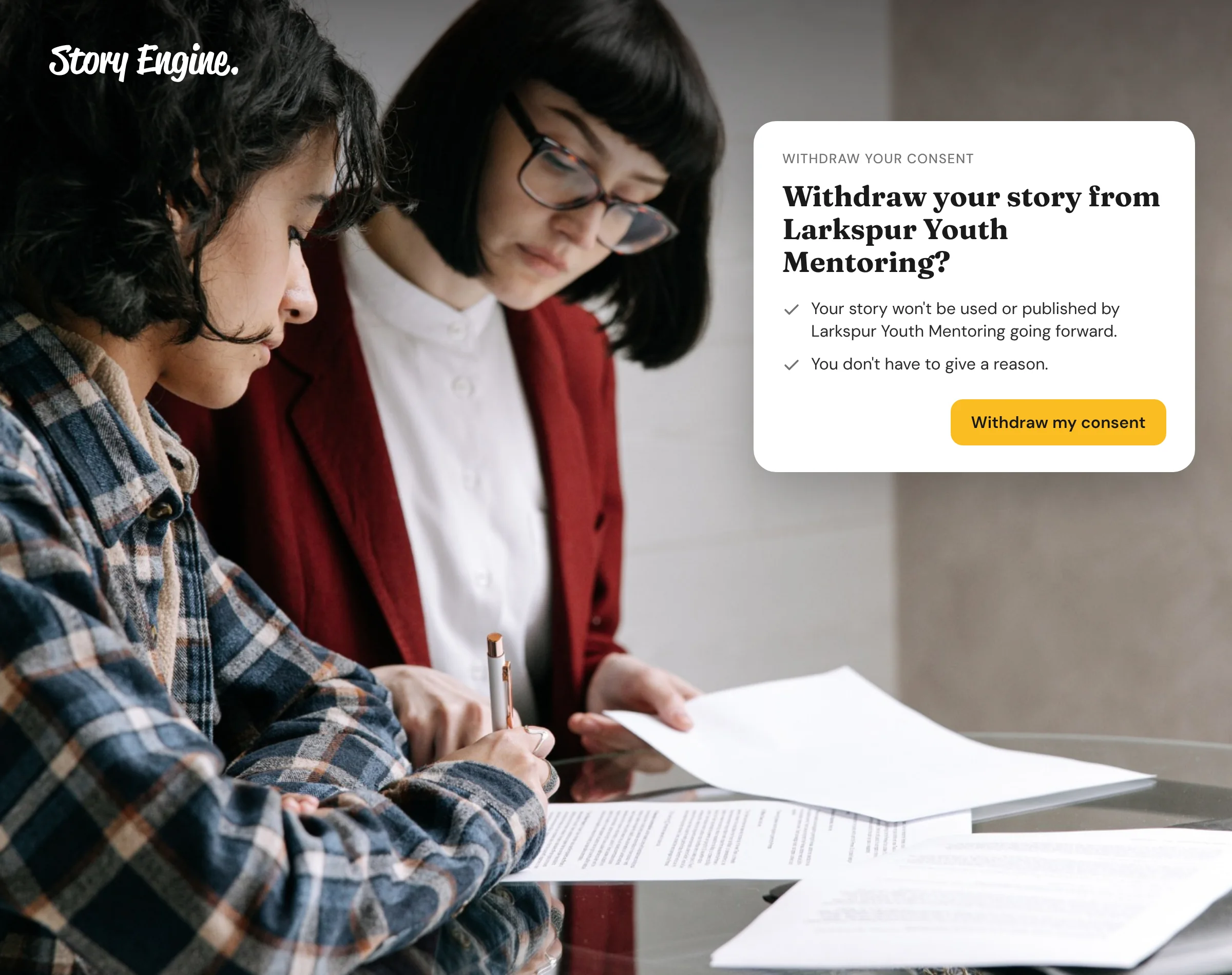
Withdrawal matters as much as the original agreement. Tell people clearly, at the moment they consent, how they can take it back and who to contact.
How do you frame stories with dignity?
In ethical storytelling, framing is how you choose to position and present a story (and the person or people within it), which directly influences what your audience focuses on and their judgments. Stories framed around suffering, lack, or crisis can reinforce harmful stereotypes, even when they are true.
An approach called asset-based framing centers a person's strengths and abilities: their skills, relationships, knowledge, and decisions. The California Health Care Foundation defines asset-framing as "a narrative model that defines people by their assets and aspirations before noting the challenges and deficits." Here's how the two compare:
| ❌ Deficit-based framing | ✅ Asset-based framing |
|---|---|
| Focuses on what a person or community lacks: • "A high-crime, food-desert community plagued by historic neglect" | Focuses on what a person or community brings: • "A neighborhood actively organizing for fair investment and safer streets" |
| Treats people as problems to be solved: • "Help us save these at-risk youth from broken homes" | Treats people as partners and problem-solvers: • "Back these young leaders as they start a mentoring program for younger students" |
| Describes the challenge first and the person second: • "Facing eviction, Sarah is a helpless single mother of three struggling to get by" | Describes skills, relationships, and knowledge first: • "Sarah, a mother and neighborhood advocate, is organizing her building's tenants after receiving an eviction notice" |
| Tends to invite pity or guilt: • "Without your gift, these children have no hope" | Tends to invite respect and partnership: • "Join the families who are building a more hopeful future for their children" |
Two other framing choices matter: systemic framing and solutions-oriented framing.
Systemic framing connects one person's situation to wider forces beyond their control, so readers understand why things are hard, not just that they are.
| ❌ Without systemic framing | ✅ Systemic framing |
|---|---|
| Treats a hardship as a personal failing: • "Devon couldn't keep up with his medication and let his health slide" | Connects the hardship to the forces behind it: • "When the town's only clinic closed, Devon and his neighbors lost easy access to the care and medication they rely on" |
| Puts the cause on individual choices: • "Families here just aren't putting healthy food on the table" | Names the conditions people are up against: • "With no grocery store within reach, families in this neighborhood must plan every meal around a long bus ride" |
Solutions-oriented framing focuses on how people are actively responding to a social or environmental problem and what is working to fix it, rather than just dwelling on the damage, tragedy, or the issue itself.
| ❌ Problem-only framing | ✅ Solutions-oriented framing |
|---|---|
| Dwells on the damage: • "The river is dying, and every year the pollution gets worse" | Shows people responding and what is working: • "Neighbors along the river are restoring wetlands and testing the water to see what's working" |
| Leaves the reader with the scale of the problem: • "Eviction notices keep rising, and there is no end in sight" | Shows a way forward: • "Tenant associations across the city are negotiating repair agreements with landlords and sharing what works" |
What is trauma-informed interviewing?
Trauma-informed interviewing reduces the chance of re-traumatizing someone by asking about painful experiences with care. It is an approach drawn from broader trauma-informed practice, whose core principles include safety, trustworthiness, and empowerment, as described in guidance from both Texas Health and Human Services and the Wisconsin Child Trauma Coalition.
If your team regularly interviews people who have experienced trauma, seek out proper training from a qualified provider.
Practical steps, drawn from guidance published by the Global Center for Journalism and Trauma and Journalists' Resource, include:
- Tell the person before the interview what topics will come up, so there are no surprises.
- Make clear they can skip any question, pause, or stop entirely at any time.
- Don't open with the hardest questions. Start with easier ones, like the person's strengths and decisions.
- Do not press for graphic detail. Trauma journalism guidance warns against pressing people to relive their worst moments.
- After the interview, tell the person what happens next and how they can reach you. Journalists' Resource recommends letting sources know when to expect the story and how their interview will be used.
If someone becomes distressed during an interview:
Stop. Do not push through. Acknowledge the distress: "It sounds like this is difficult. We can stop here." Give the person space to decide whether to continue. If they want to stop, let them stop, and do not frame continuing as a favor to your organization.
After the interview, follow up. Check in with the person in the days after, particularly if the conversation was difficult. If someone appears to be in acute distress, refer them to appropriate support. Know in advance what support resources you can offer or point to, whether that is a counselor, a helpline, or a designated person at your organization.
If you are not sure whether your team is equipped to handle the conversation, that is a sign to involve a trained professional before you begin.
What extra care is needed for sensitive topics and circumstances?
Some stories carry risks that go beyond general privacy. Stories involving abuse, domestic violence, immigration status, mental health, or other stigmatized situations can cause real harm to a person if identifying details are published, even when the person originally agreed to share.
Bond's digital ethical guidelines warn that sharing images "could lead to risks for themselves or their families." Where risk is present, you have a responsibility to:
- Use a pseudonym and remove identifying details
- Leave out photographs, or use only photos that do not show the face or other identifying features
- Think carefully about whether the story needs to name a location, an employer, or a family member
Stories involving children require additional steps. UNICEF's reporting guidelines state that permission must be obtained in circumstances that ensure the child and guardian are not coerced in any way, and that both understand what they are agreeing to.
UNICEF also advises that a chaperone or guardian should be present during an interview with a child, and that when in doubt about whether a child is at risk, it is better to report on the general situation rather than on an individual child.
Do not ask children to tell a story or take an action that is not part of their own history.
Consent from a parent or guardian does not replace the child's own assent. Explain to the child, in age-appropriate language, what will happen with their story, and give them a genuine opportunity to say no.
When to involve professionals or your organization's safeguarding policies:
If a storyteller discloses abuse or harm during an interview, this may trigger a reporting obligation depending on your jurisdiction and the nature of the disclosure. Know your organization's safeguarding policy before you begin collecting stories, not after.
If you do not have one, speak with your legal counsel or a safeguarding lead about putting one in place. This guide cannot tell you what your obligations are in your specific context.
How to manage consent and dignity in Story Engine
Story Engine is a tool for collecting stories with consent and care built into the process. It does not replace human judgment, human follow-up, or the professional guidance described above. Use it alongside your organization's policies, not instead of them.
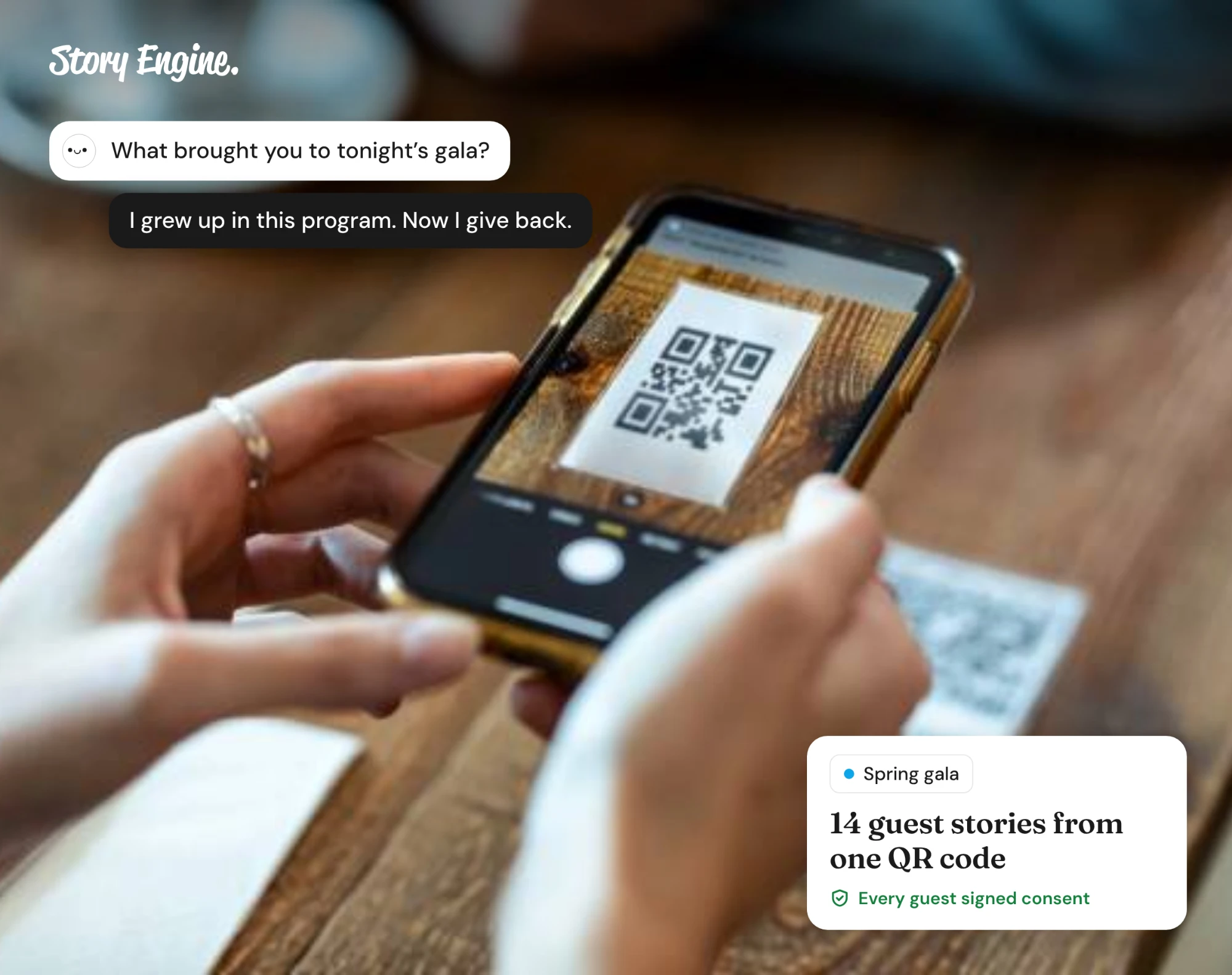
Every interview in Story Engine begins with a consent form that the person signs before they answer anything. Signed forms are stored automatically. Here is how to set up an interview that follows ethical storytelling practice:
1. Create the interview
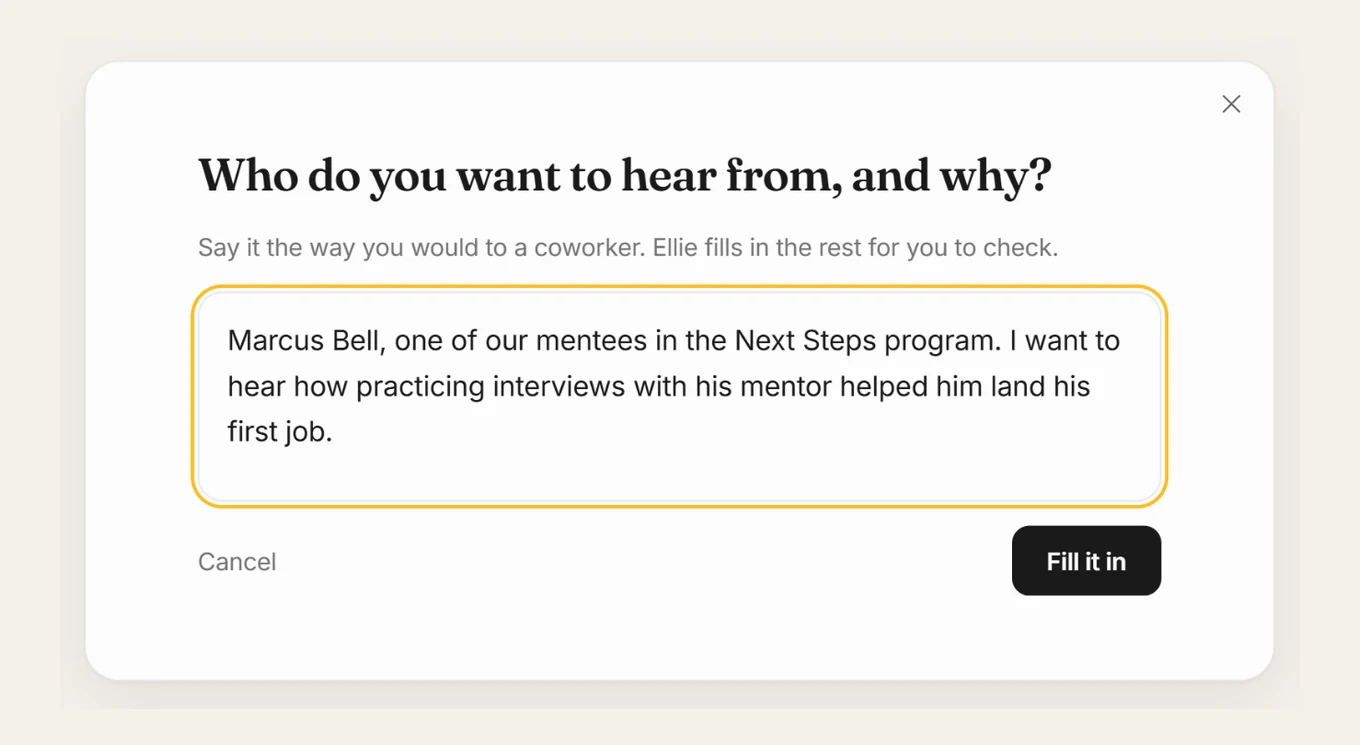
Go to Interviews and select New interview, then From one person. Describe who you want to hear from and why. Press Fill it in and Ellie will draft the interview for you, including the questions.
2. Review every question
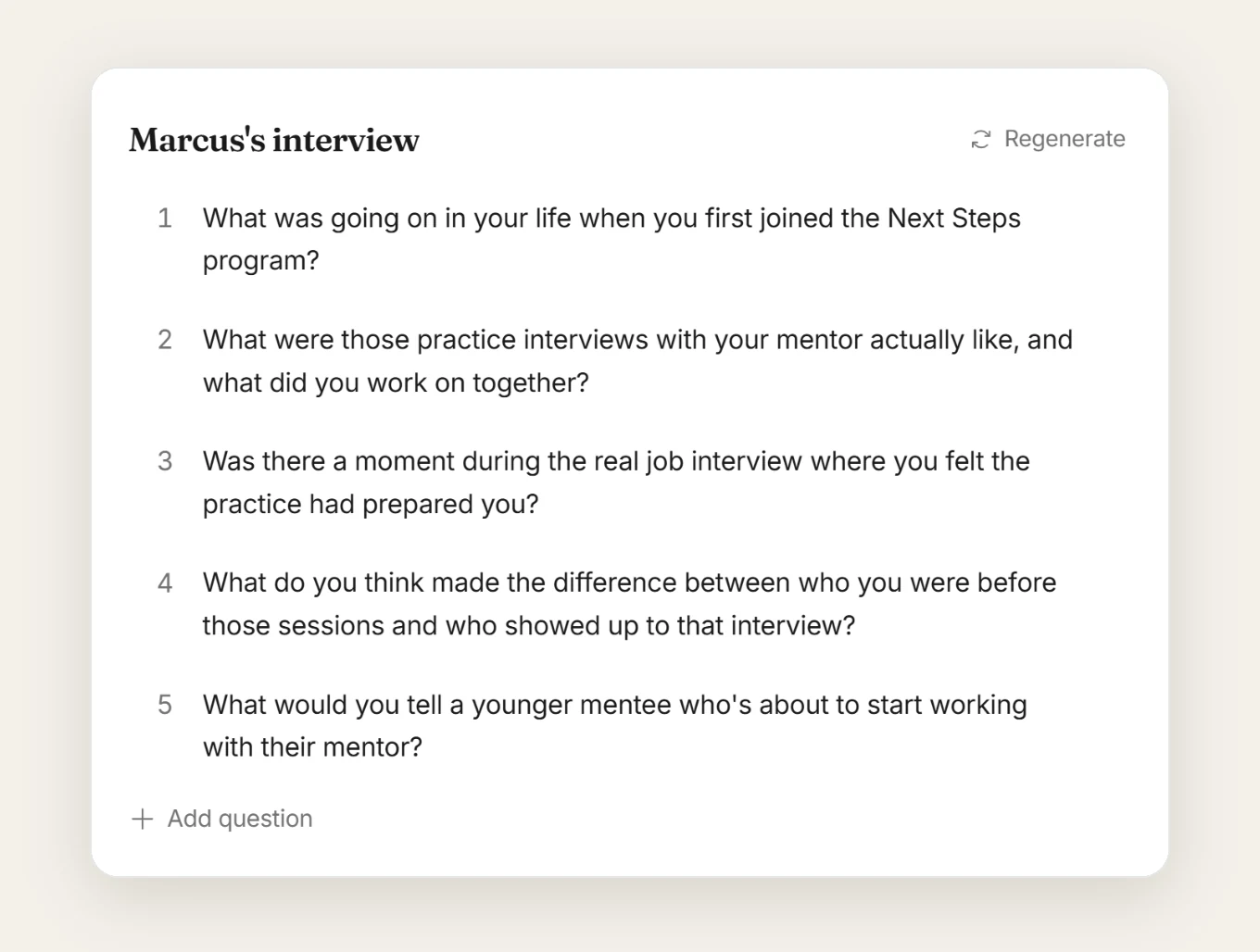
On the left side of the interview setup, check each question before sending. Ellie is designed to write questions with care, but AI can make mistakes. Remove or rewrite any question that asks for more pain or detail than is necessary.
Ensure questions about the person's strengths and decisions are always included (if none are generated, you can include them yourself through Add question). This review is your responsibility: Ellie drafts a starting point, but you must check for and correct any issues before involving your storyteller.
3. Turn on Sensitive topic if it applies
On the right side of the setup, find the Sensitive topic switch. Ellie turns this on automatically for certain topics, but it can miss one, so always check it and turn it on yourself if it applies. This switch ensures that the 988 Lifeline and the Crisis Text Line are plainly visible before and during the interview.
We do not generally recommend AI interviewing for highly sensitive and potentially triggering topics, but every situation is different, so the choice is up to you and your storytellers. Either way, the safeguards stay in place: a visible crisis line, the freedom to skip questions or stop at any time, and the option to withdraw consent later.
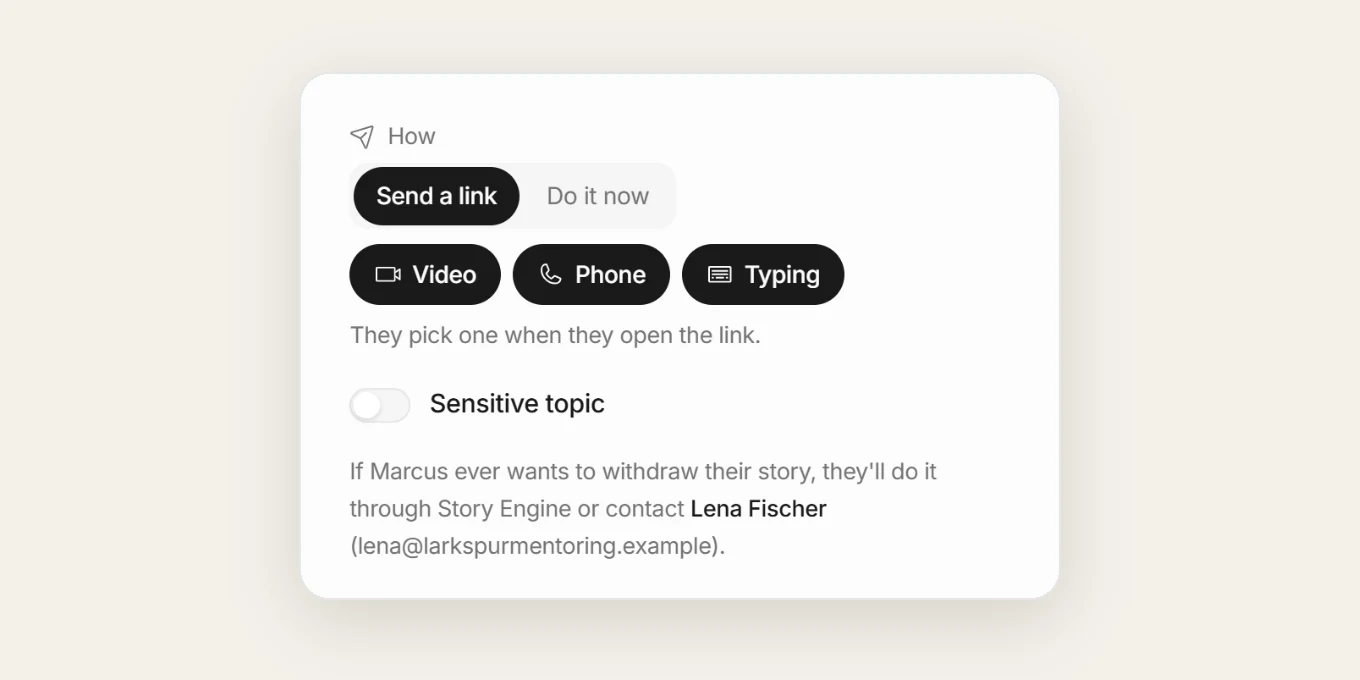
4. Set the consent contact
The first time you send an interview, you'll be asked who storytellers should contact to withdraw consent. That person's name and email appear on every signed consent form, so storytellers always have a way to reach you, even if your team stops using Story Engine.
Storytellers can also withdraw on their own from the link in their consent email. You can change the contact anytime in Settings › Team, in the Consent and checks section.
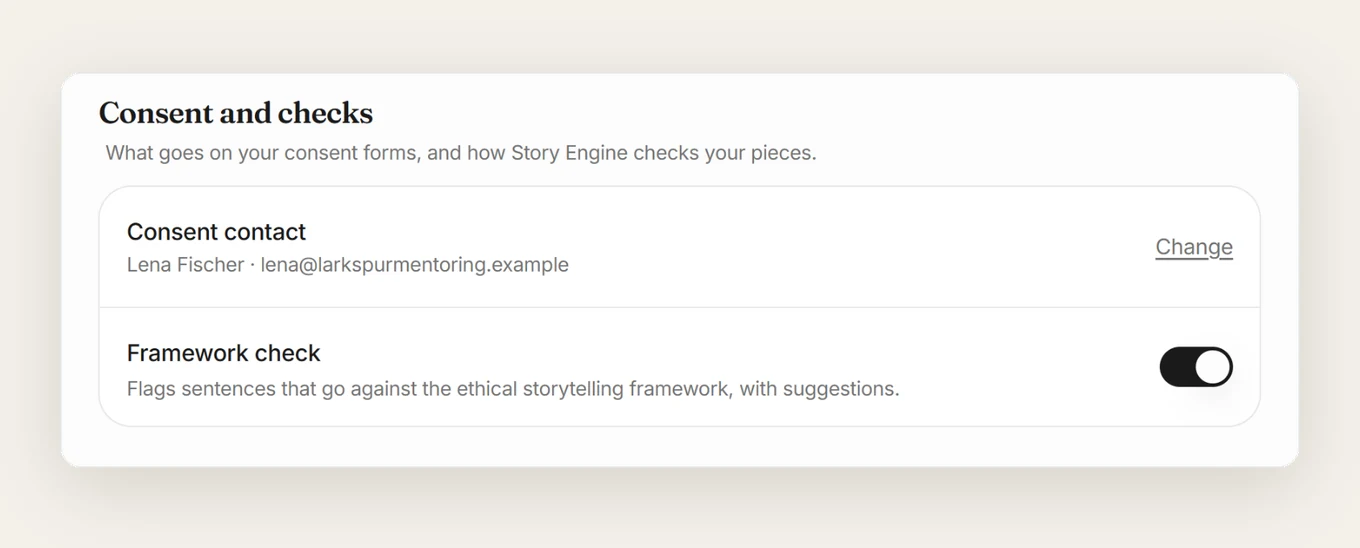
5. Send the invite
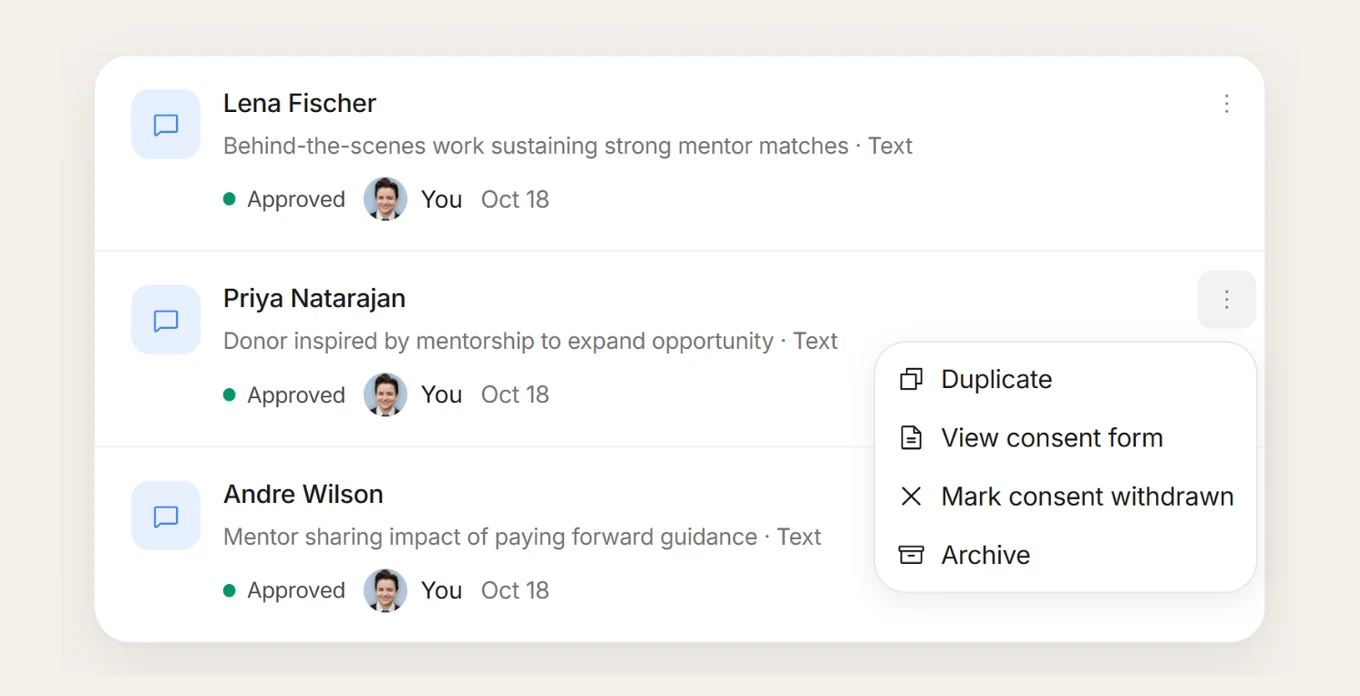
Press Send invite. The person receives an email with a link to sign a consent form before they begin. After they respond, you can view their consent form from the interview's row menu (the ⋯ on their row).
No summary or transcript of the interview will be available until the storyteller reviews and confirms they are happy with what was shared. They also have the option to redo any answer, or the entire interview before approving it if they wish.
How do you stay accurate and accountable?
Accuracy in storytelling means the facts, quotes, and context are correct, and the story as a whole is not misleading even if every sentence is technically true.
Before publishing:
- Share a draft with the storyteller and let them correct anything they feel misrepresents them.
- Check that quotes are verbatim or clearly paraphrased.
- Do not add emotional detail the person did not give you.
- Do not use the story in a way the person did not consent to.
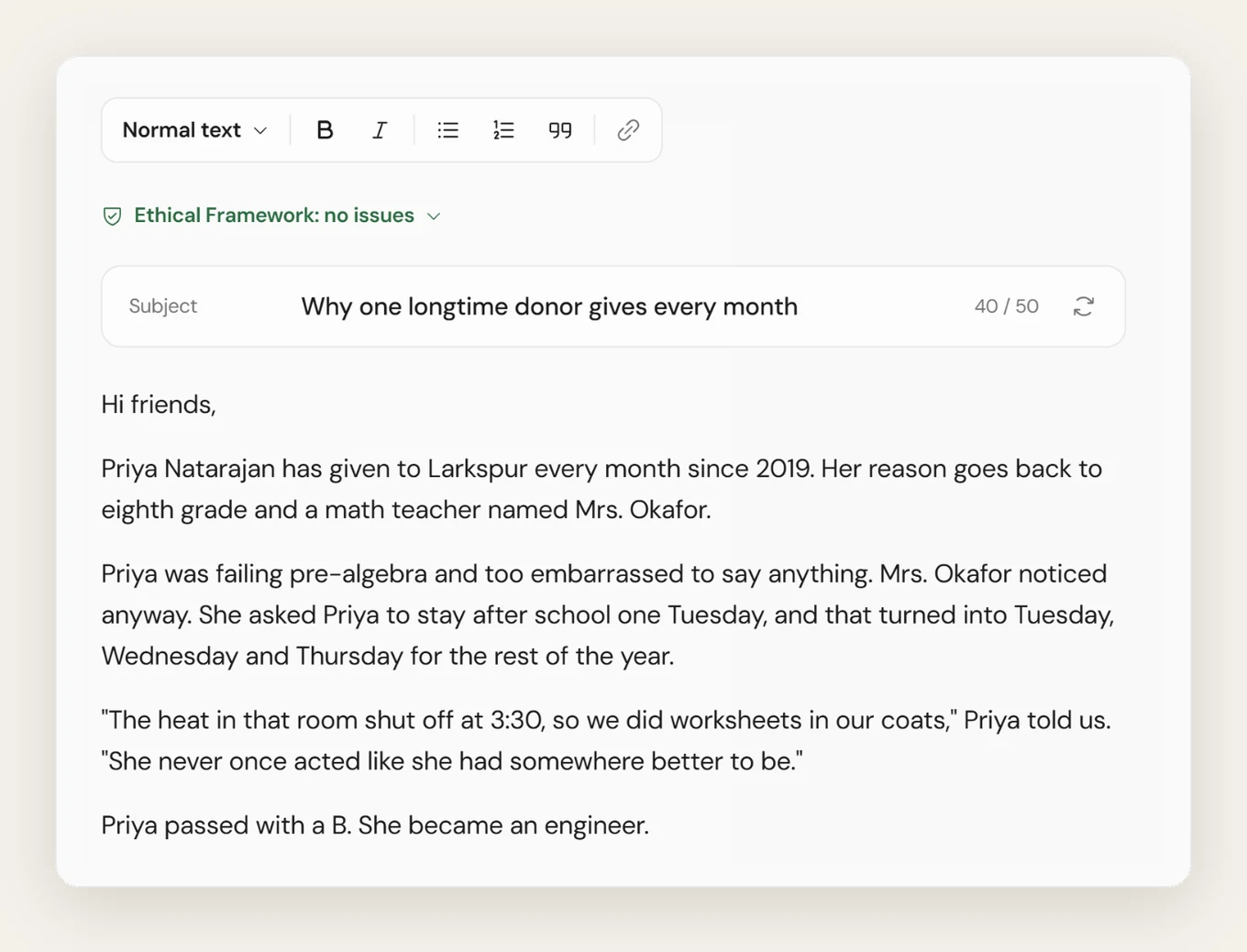
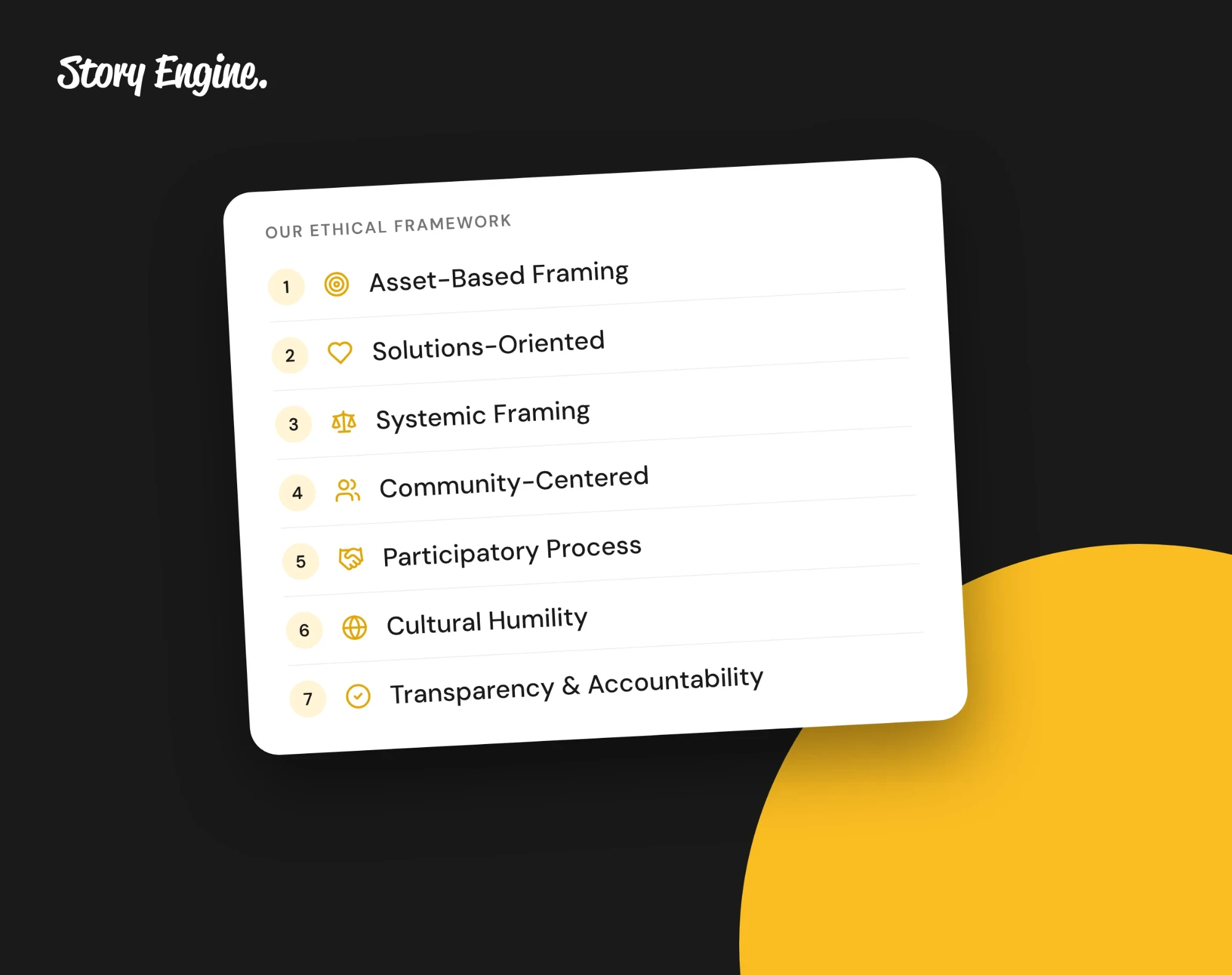
In Story Engine, the Ethical Framework check in the editor can flag framing that leans toward deficit language or pity appeals. It is a prompt to review your draft, not a guarantee of accuracy.
Always review a draft yourself before publishing (even if you purchase Human Review through Story Engine to get a first or second look by a professional writing partner), and remember that AI can make mistakes.
Frequently asked questions
Do we need a new consent form every time we reuse a story?
Yes, if the new use was not covered in the original consent. For example, if someone consented to a newsletter feature and you now want to use their story in a fundraising appeal, ask again. SOS Children's Villages' ethical storytelling guidelines recommend reconfirming consent when time has passed or the use changes. In Story Engine, the consent form is tied to each interview, so you can view what was agreed to from the interview's row menu using the ⋯ options.
What if someone becomes distressed after an interview?
Follow up with them directly, and have a list of support resources ready to share. If someone appears to be in acute distress or discloses harm, follow your organization's safeguarding policy and involve a qualified person. Story Engine shows a crisis line before and during sensitive interviews, but following up is your team's job.
What if someone withdraws consent after a story is already published?
Remove the story from active use as quickly as you can. Take it down from your website and social channels, and do not reuse it. In Story Engine, any team member can use Mark consent withdrawn from the interview's row menu, and the person can also withdraw themselves from the link in their consent email. Bond's 2025 guidance is clear that participants must be able to withdraw at any point. For a full walkthrough of what to do when that happens, see how to handle consent withdrawal after publishing.
How do we handle stories from people in sensitive circumstances, like immigration or abuse?
Assess the risk before you collect the story. Consider whether publishing any identifying details could harm the person or their family. Use pseudonyms, remove identifying details, and avoid photographs of faces. If the topic involves abuse or legal risk, consult your organization's safeguarding lead or legal counsel before proceeding. Story Engine's Sensitive topic switch keeps a crisis line visible before and during the interview, but it does not remove the need for human judgment about whether and how to proceed.
Start with one interview done right
Before you collect your next story, review your organization's safeguarding policy and decide in advance what you will do if someone discloses harm or becomes distressed. Then review the questions for asset-based framing, confirm the withdrawal contact, and send the interview with its consent form.
For the whole process, see how to collect impact stories. If photos of the people you serve are not an option, see how to show impact without photos.
Sources
- Consent collection for ethical storytelling – Bond, 2025
- Ethical guidelines for the collection and use of content – Bond, 2022
- Digital ethical guidelines – Bond, 2024
- Understanding Asset-Framing Guidelines for CHCF Authors – California Health Care Foundation, 2021
- Six Key Principles of a Trauma-Informed Approach – Wisconsin Child Trauma Coalition
- Six Principles of Trauma-Informed Care – Texas Health and Human Services, 2025
- Trauma-informed journalism: What it is and why it's important + tips – Journalists' Resource
- Trauma-informed journalism: What it is, why it's important and tips – Trauma Journalism
- Ethical reporting guidelines – UNICEF
- Reporting guidelines to protect children – UNICEF Hong Kong
- Guidelines for journalists – UNICEF China
- Ethical Storytelling Guidelines User guide March 2026 – SOS Children's Villages, 2026
- Asset-Framing in Email Fundraising – DonorsChoose, 2023
About the authors

A nonprofit copywriter and partner at Good Creatives.

Founded the agency Good Creatives in 2015, recognized by the American Institute of Graphic Arts.